


- Home
- Production BEL original
- Controller DMR4316AC with display
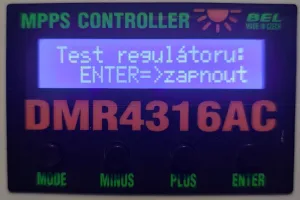
Controller for boiler suplying from solar panels DMR4316AC
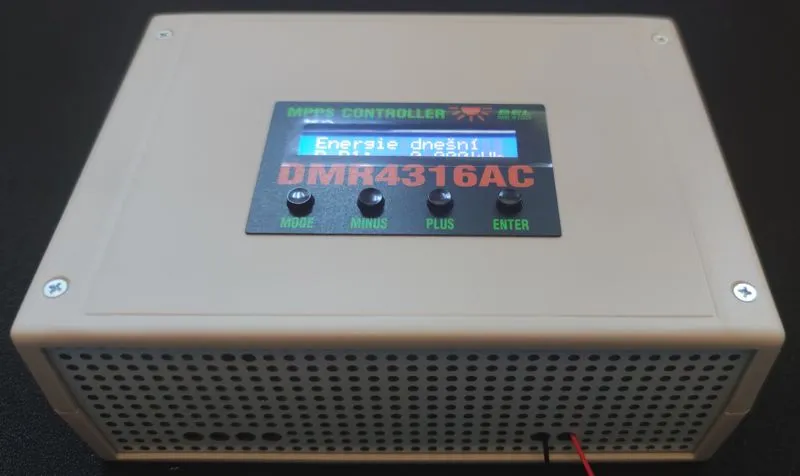
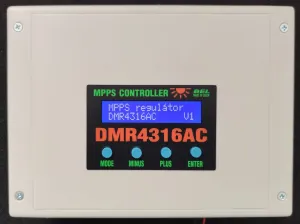
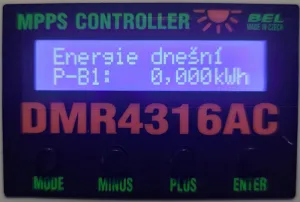
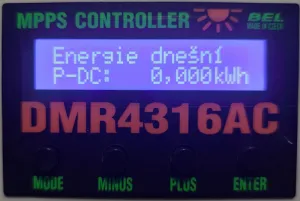
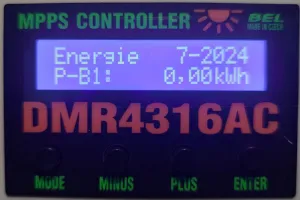
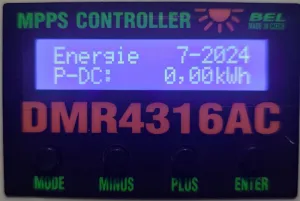
Basic description: controller for optimalized AC boiler and solar panel connection, input voltage 60 to 430 V, current 16 A. Controller has one AC output and one DC output. Power is indicated by LCD display.

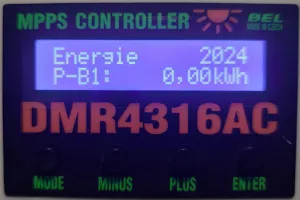
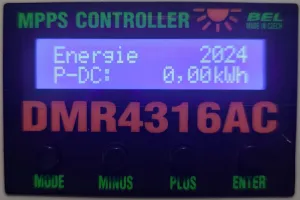
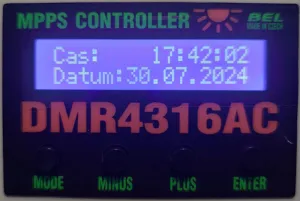
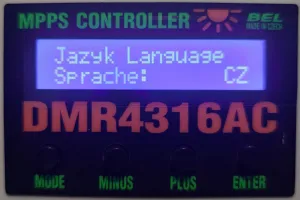

| Manufacturer: | BEL |
| Price with VAT: | 6 750,00 Kč |
| VAT: | 21 % |
| Discount: | 750,00 Kč |
| Original price with VAT: | 7 500,00 Kč |
| Availability: | In stock |
| !_prehled mnozstevnich slev_! | Quantity (pcs) | Price without VAT | Price with VAT | |
| 1 + | 6 198,30 Kč | 5 578,50 Kč | 7 500,00 Kč | 6 750,00 Kč |
| 3 + | 6 198,30 Kč | 5 578,50 Kč | 7 500,00 Kč | 6 750,00 Kč |
| 10 + | 6 198,30 Kč | 4 958,70 Kč | 7 500,00 Kč | 6 000,00 Kč |
Want to save money on water heating or heating? Read on. Do you own a cottage and need to heat water in a boiler in summer and temper the building with a conventional direct-fired heater in winter? And not pay for energy? You want to know how much free energy you are getting. This is also possible, thanks to the built-in display you can find out how much power the controller heats the water with, as well as how much energy it has supplied in the previous days, months and years. But beware, the connected device must be purely resistive without additional electronics (display, electronic thermostat, fan, etc.) and must be switched off by a mechanical thermostat.
The DMR4316AC controller optimises the adjustment of the resistance of the heating coil of the boiler and the photovoltaic panels to maximise the energy recovered from the panels. It connects between the solar panels and the boiler heating coil. It is designed for wall mounting. The output voltage at the output is AC, so the controller can be used with a conventional boiler with a heating coil for AC voltage.The input voltage can be from 60 to 430 V. Only appliances with a purely resistive character (boiler without electronics, underfloor heating, direct heater without fan, infrared heater, etc.) with an input of up to 2500 W (with active cooling up to 4000 W) can be connected to the output. The controller stores the last 120 days of daily energy, the last 36 months of monthly energy and the last 10 years of annual energy.
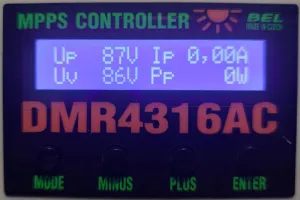
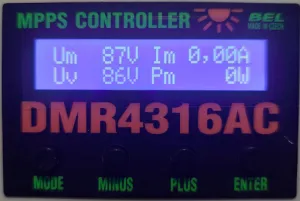
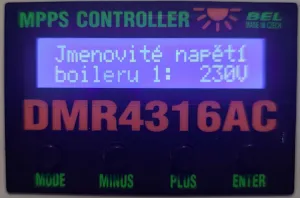
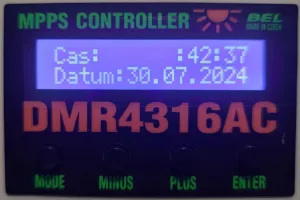
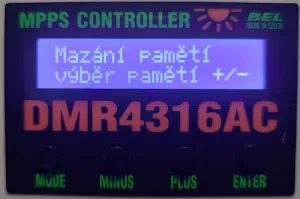
The controller uses a new method of active Maximum Power Point Searching (MPPS) when powering the boiler. This method eliminates power losses compared to the MPPT method when the PV panels do not have the same characteristics, power rating, temperature changes or are not evenly illuminated. The measured data (voltage, current, power, temperature, energy) are displayed on a two-line LCD display. The controller also has a DC output to which the panel voltage is automatically redirected if the appliance is disconnected at the AC output. The controller can operate in four modes of operation, which are described in the following text. Many control parameters can be set and stored in the processor's memory using four buttons: mode of operation, panel test period, DC output on time, DC output load wait time, minimum DC output power, maximum output voltage, nominal load power, heated water volume, minimum required water temperature, and minimum allowable panel voltage. Up to two DS18B20 digital temperature sensors can be connected to the controller to measure e.g. boiler water temperature. Note: The controller uses pulse-width modulation, which may produce a low hum from the heating coil that could disturb the quietness of the room in which the appliance is located.
Optimal power supply for the controller:
Panel voltage must be neither too low nor too high. If the voltage is too low, it will not be possible to push the power of the panels into the appliance; too high a voltage will force the controller to operate at a disadvantage or may even damage it. The optimum supply voltage should be between 100 and 115% of the nominal load voltage (this is usually 230 V). The supply voltage is calculated as the product of the number of panels in series and their voltage at the operating point (the lower voltage value in the panel documentation). The optimum peak power of the panels (again see panel documentation) should be between 100 and 150 % of the load power. Compliance with these conditions will give the most favourable cost/energy ratio. If you want to use higher panel voltages, the rated voltage of the appliance must be increased so that the supply voltage is again between 100 and 115% of the rated voltage of the appliance. But even in this case, the maximum number of panels in series can only be such that their no-load voltage never exceeds 430 V. Checking is easy. In the documentation for the panels you can find the no-load voltage (this is the highest value given), multiply this by 1.15 to calculate the voltage of the panels at an outdoor temperature of -25 deg. C. Multiply the resulting voltage by the number of panels in the series. The calculated voltage must always be less than 430 V! If it is not, the number of panels must be reduced!
Basic technical data:
Input: DC, voltage 60 to 430 V**, current up to 16 A** (photovoltaic panels only),
Outputs: AC (resistive appliance only, regulates matching to panels), DC (inverter or auxiliary circuitry, only transfers panel voltage to output)
Starting voltage of the panels: DC: 70 V (the controller switches on)
Minimum panel voltage: DC: 30 V (controller turns off)
Maximum power: 2500 W without cooling, 4000 W with active cooling
Optimum voltage of loaded panels: 100 to 115% of the nominal voltage of the connected appliance
Optimal peak power of panels: 100 to 150 % of the rated power of the connected appliance
Display voltage: 30 to 430 V, 1 V resolution
Voltage measurement accuracy: ±1 % of measurement range
Displayed current: 0 to 16 A, 10/100 mA resolution
Current measurement accuracy: ±1 % of the measuring range
Displayed power: 0 to 4000 W, 1 W resolution
Displayed energy: daily 0 to 65 kWh, monthly 0 to 1.3 MWh, annual 0 to 3.9 MWh
Temperature display: 0 to 100 °C, resolution 1 °C
Daily energy memory depth: 120 days + today's day
Monthly energy memory depth: 36 months
Annual energy memory depth: 10 years
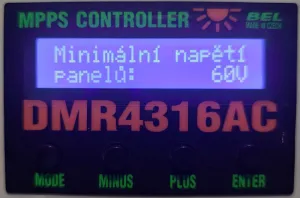
Minimum allowable panel voltage: adjustable from 60 to 250 V
Maximum AC output voltage: adjustable from 50 to 320 V (not to exceed maximum)
AC output frequency: 121 Hz
DC output voltage: 60 to 430 V (same as actual panel voltage)
Max. capacitance at DC output: 2000 µF at 160 V, 1000 µF at 300 V, 500 µF at 430 V
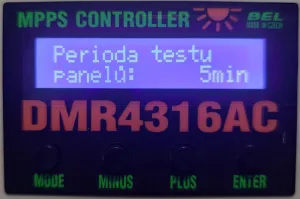
Panel testing period: adjustable from 1 to 20 minutes
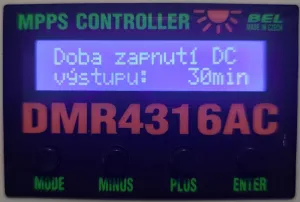
DC output on time: adjustable from 3 minutes to 120 minutes
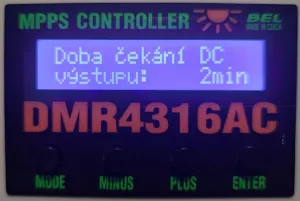
DC output waiting time: adjustable from 1 minute to 10 minutes
Minimum DC output power: adjustable from 10 to 250 W
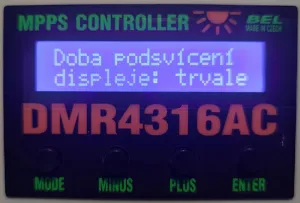
Display: LCD, backlit, 2 x 16 characters
Display language: Czech (CZ), English (EN) or German (DE)
Control buttons: four (MODE, PLUS, MINUS, ENTER)
Power consumption: max. 1 W
Battery for real-time circuit: 3 V lithium, CR2032
Operating temperature range: -20 °C to +35 °C
Ambient humidity: 10 to 90% RH (non-condensing)
Dimensions: 190 x 140 x 70 mm
Cross-section of lead wires: from 1 to 2.5 mm2
Mounting: upright, free space below and above 50 mm (for cooling)
Related items - Controller for boiler suplying from solar panels DMR4316AC

Availability: In stock
| Price with VAT | 1 650,00 Kč |
| Discount | 550,00 Kč |
| Original price | 2 200,00 Kč |

Availability: In stock
| Price with VAT | 480,00 Kč |

Availability: In stock
| Price with VAT | 1 526,00 Kč |
| Discount | 654,00 Kč |
| Original price | 2 180,00 Kč |

Availability: In stock
| Price with VAT | 100,00 Kč |

Availability: Week
| Price with VAT | 400,00 Kč |

Availability: In stock
| Price with VAT | 5,00 Kč |

Availability: In stock
| Price with VAT | 5,00 Kč |

Availability: In stock
| Price with VAT | 1 215,00 Kč |
| Discount | 135,00 Kč |
| Original price | 1 350,00 Kč |
Availability: In stock
| Price with VAT | 300,00 Kč |

Availability: Week
| Price with VAT | 450,00 Kč |
Availability: Week
| Price with VAT | 520,00 Kč |
Availability: In stock
| Price with VAT | 280,00 Kč |
