


- Home
- Production BEL original
- Programmable appliance switch PSS1
Programmable appliance switch PSS1
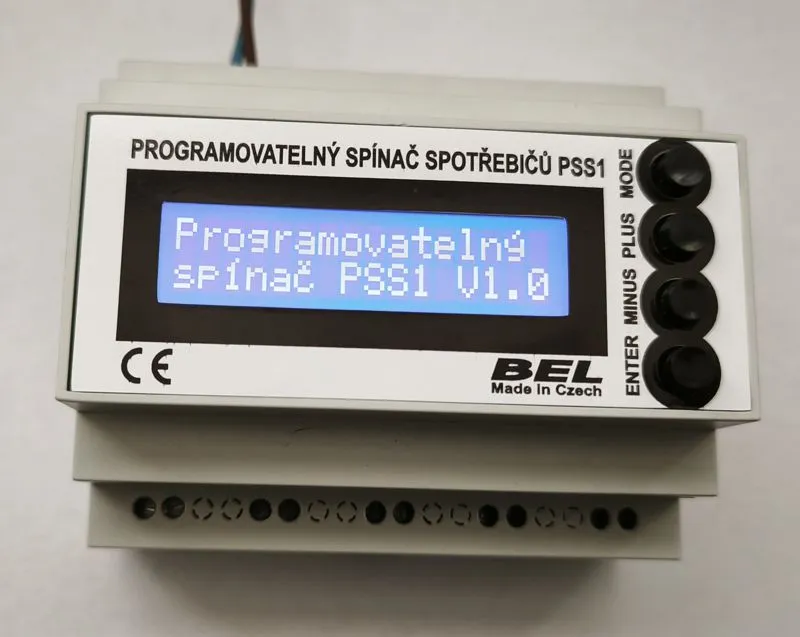
Basic description: The PSS1 programmable appliance switch is designed to switch up to five appliances at a set time or according to the price of electricity.
| Price with VAT: | 3 060,00 Kč |
| VAT: | 21 % |
| Discount: | 340,00 Kč |
| Original price with VAT: | 3 400,00 Kč |
| Availability: | In stock |
| !_prehled mnozstevnich slev_! | Quantity (pcs) | Price without VAT | Price with VAT | |
| 1 + | 2 809,90 Kč | 2 528,90 Kč | 3 400,00 Kč | 3 060,00 Kč |
| 3 + | 2 809,90 Kč | 2 528,90 Kč | 3 400,00 Kč | 3 060,00 Kč |
| 10 + | 2 809,90 Kč | 2 247,90 Kč | 3 400,00 Kč | 2 720,00 Kč |
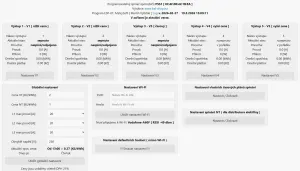
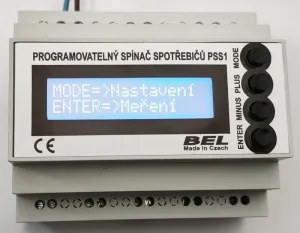
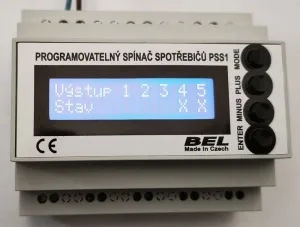
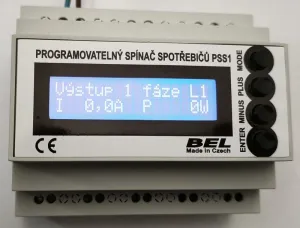
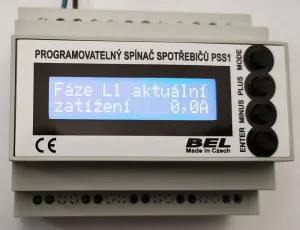
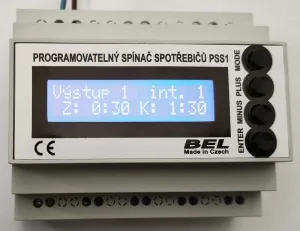
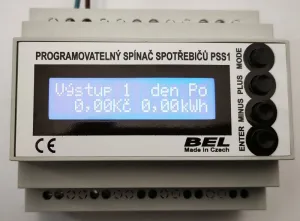
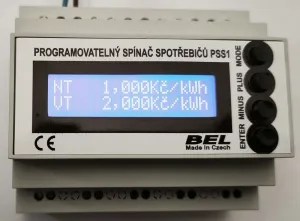
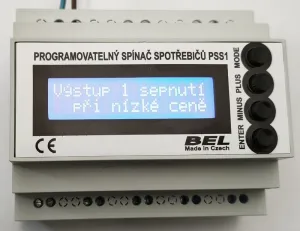
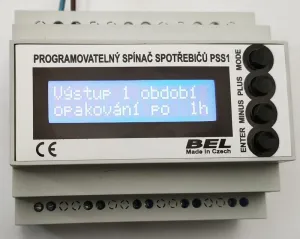
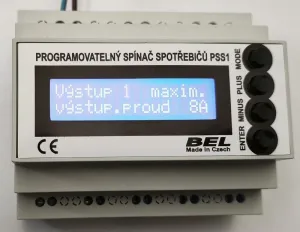
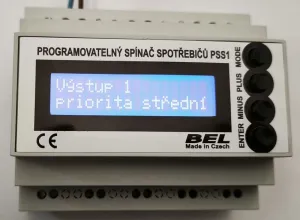
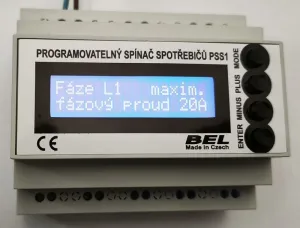
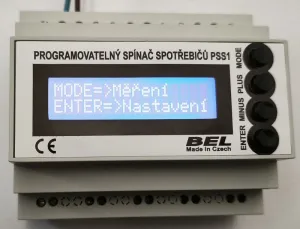
The PSS1 programmable appliance switch is a switch with 5 outputs that can be switched according to a user-set schedule or according to the current (15-minute) price of electricity on the spot market. The switch on each output measures the current and calculates the power consumption of the connected appliance and the total energy consumed by the appliance that day. The switch can connect to the internet via built-in Wi-Fi, from where it automatically downloads the current time and spot electricity prices, or connect to a phone or computer on the local network. The web browser application can display the current status of the outputs, measured values of current output or phase currents, power consumption, daily energy consumption, and payment for it. The switch itself can be set to select the switching mode, repetition period, total switch-on time, output switch-on and switch-off times, maximum output current, output priority, phase number to which the output is connected, maximum phase current, and typical mains voltage at the installation site.
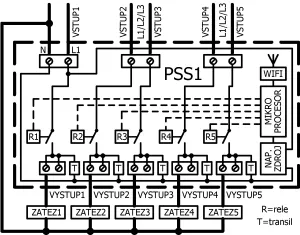
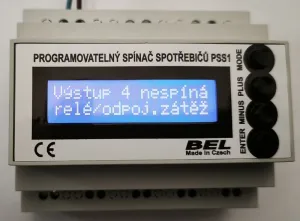
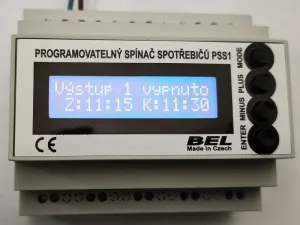
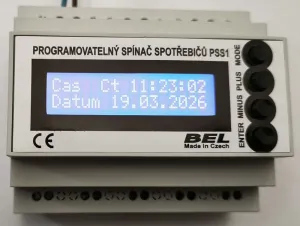
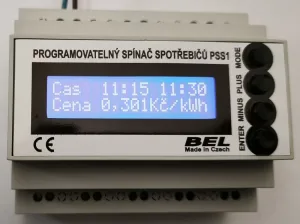
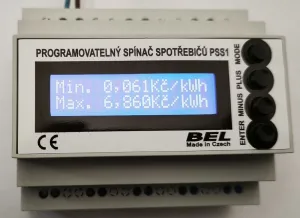
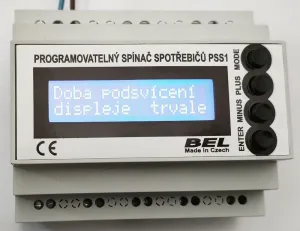
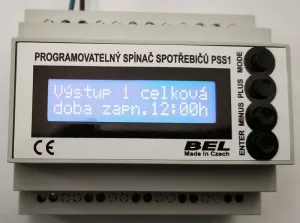
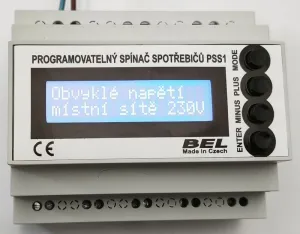
The switch can be powered by an AC voltage of 210 to 250 V, and each output can switch a current of up to 16 A. The measured and set data are displayed on a two-line backlit LCD display. There are four buttons on the front panel for control. The switch is housed in a plastic box for mounting on a DIN rail. There are 6 terminals (5 input wires and one neutral wire) in the upper part and a total of 10 screw terminals (5x2 output wires) in the lower part of the box for connection to the electrical circuit.
How does a programmable switch work?
The switch inputs are connected between any phase of the network and the appliance. It is powered directly from the network connected to the first input. It continuously measures the current flowing through each output and calculates the displayed values from the measured values every second: the effective value of the output current, phase current, real power consumption, and daily energy consumption and its price.
It switches the individual outputs at fifteen-minute intervals according to the selected switching mode, either at user-set times or when electricity prices on the spot market are low or high. The switch obtains information on electricity prices automatically every day from the Internet. If the user chooses switching based on the price of electricity, the switch must therefore be connected to a network with internet access. In order to take advantage of low spot prices, the user must have a spot tariff agreed with their electricity supplier.
If the output is overloaded, it is temporarily switched off. If the maximum phase current is exceeded, the switch automatically temporarily switches off enough outputs to reduce the current to the selected maximum, giving priority to switching off outputs with lower priority and higher output numbers.
In what situations is a programmable switch used?
Each output can be set to any of three switching modes:
Switching at a set time: the user can set the switch-on and switch-off times for each output in intervals of 2 to 48 hours (depending on the selected repetition length). The switch will repeat the switching on and off of the output throughout the day for all repetition periods. For example, if the repetition period is set to 6 hours and switching is set from 0:00 to 1:00, the relevant output will repeat this pattern every 6 hours, i.e. it will be switched on from 0:00 to 1:00, from 6:00 to 7:00, from 12:00 to 1:00 p.m., and from 6:00 to 7:00 p.m. Examples of use: switching on an appliance when the user needs it to be on, e.g., lighting at night, heating only when people are present, regular switching on of pool filtration, limiting the simultaneous switching on of multiple energy devices at once (to reduce peak load on the grid, which allows the use of a main circuit breaker with a lower current = lower monthly fees for reserved power) by appropriately scheduling the switch-on times of individual outputs, etc.
Switching during periods of low electricity prices: the user can set the total output switch-on time within 24 hours, or even the repetition period. The switch finds the proportional number of quarter-hours with the lowest electricity price in each repetition period and switches on the corresponding output only during these quarter-hours. For example if the repetition period is set to 6 hours (i.e., the period repeats 4 times a day) and the total output switch-on time is 8 hours (i.e., 4 x 2 hours), the switch selects two hours (eight quarter-hours) with the lowest price within all six-hour periods and switches on the corresponding output during these quarter-hours. Examples of use: switching on appliances whose exact time of switching on during the day is irrelevant, at a time when the price of electricity on the spot market is lowest. Such switching helps to save electricity costs. It can be used for appliances with high inertia, where it does not matter when they are switched on, such as heating, water heating, swimming pool water filtration, etc.
Switching during periods of high electricity prices: the user can set the total output switch-on time within 24 hours, or even the repetition period. The switch finds the proportional number of quarter-hours with the highest electricity price in each repetition period and switches on the corresponding output during these quarter-hours. For example if the repetition period is set to 6 hours (i.e., the period repeats 4 times a day) and the total output switch-on time is 8 hours (i.e., 4 x 2 hours), the switch selects two hours (eight quarter-hours) with the highest price within all six-hour periods and switches on the corresponding output during these quarter-hours. Examples of use: blocking appliances (similar to HDO relays) whose exact operating time during the day is irrelevant at times when the price of electricity is highest. Such switching helps to save electricity costs. It requires a tariff with spot electricity prices. It can be used for appliances with high inertia, where it does not matter when they are switched off and on, such as heating.
Basic technical data:
Input voltage: 210 to 250 V/50 Hz
Switched current: resistive appliance (e.g., boiler): up to 16 A
inductive appliance (e.g., electric motor): up to 8 A
capacitive appliance (e.g., switched power supply): not permitted
Measured effective current: ±0 to 16 A, resolution 0.1 A
Actual power consumption: ±0 to 4000 W (at 250 V and 16 A)
Energy: ±0 to 96 kWh, resolution 0.01 kWh
Energy price: ±0 to 3000 CZK, resolution 0.01 CZK
Switching modes: at a set time, when electricity prices are low, when electricity prices are high
Repetition period length: 1, 2, 3, 4, 6, 8, 12, or 24 hours
Total switch-on time: 0 to 24 hours, step depends on the length of the repetition period
Maximum output current: adjustable from 1 to 16 A, step 1 A
Maximum phase current: adjustable from 5 to 80 A, step 5 A
Display: LCD, backlit, 2 x 16 characters
Control buttons: four (MODE, PLUS, MINUS, ENTER)
Current measurement accuracy: ±1% of range
Power consumption: max. 0.5 W
Operating temperature: 0 to 40 °C
Operating humidity: up to 80%
Dimensions: 90 x 104 x 65 mm, DIN rail mounting
Supply cable cross-section: 1 to 2.5 mm2
